Precision 316 / 316L Stainless Steel CNC Machining
PRECI5 provides high-precision CNC machining for 316 and 316L stainless steel components. These austenitic stainless steels are standard requirements for medical devices, semiconductor equipment, and fluid handling systems due to their superior corrosion resistance and weldability. Machining these alloys requires specific technical expertise to manage work hardening and maintain tight dimensional tolerances. We utilize our 5-axis machining infrastructure to deliver complex, high-quality 316L precision parts for your engineering requirements.
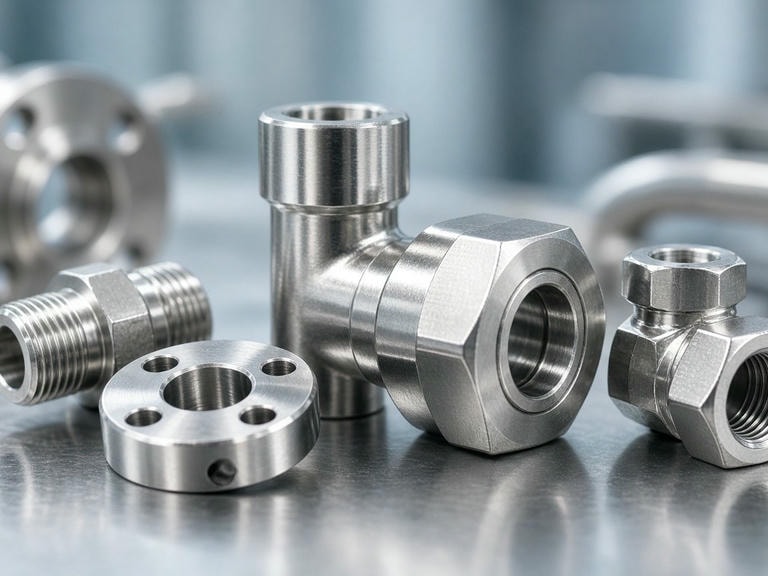
316 vs. 316L Stainless Steel: Engineering Considerations
Understanding the distinction between 316 and 316L is critical for component design and manufacturing selection across 316 stainless machining workflows.
316 Stainless Steel
Contains a higher carbon content, which provides higher strength but makes it more susceptible to carbide precipitation during welding. It is often used in applications where structural strength is the primary driver.
316L Stainless Steel
The “L” stands for “Low Carbon.” With a maximum carbon content of 0.03%, 316L is specifically engineered to prevent carbide precipitation during welding, making it the preferred choice for components that require extensive welding or fabrication.
Material Property Comparison (Typical Annealed State)
Nominal mechanical and thermal benchmark values for engineering calculation
| Property | 316 / 316L Stainless Steel |
|---|---|
| Density | 8.0 g/cm³ |
| Tensile Strength | 485 – 515 MPa |
| Yield Strength | 170 – 205 MPa |
| Hardness | 95 HRB |
| Elongation | 40 – 50% |
| Thermal Conductivity | 16.2 W/m·K |
Addressing Machining Challenges
Stainless steel 316/316L is notorious for work hardening, where the material becomes harder and more brittle if the cutting tool rubs rather than cuts. Our process engineering team manages this through several critical controls:
Work Hardening Mitigation
We maintain positive rake angles and ensure that cutting tools are sharp. Our machining parameters prioritize constant feed rates to prevent the tool from dwelling on the work surface, which creates localized hardening.
Heat Management
316/316L has low thermal conductivity. We utilize high-pressure coolant systems to evacuate heat from the cutting zone, protecting both the part dimensions and tool life.
Surface Finish
To achieve the required surface integrity, we balance spindle speeds and feed rates to minimize vibration (chatter). This is essential for components used in vacuum environments or precision fluid assemblies.
Passivation
Following machining, we manage post-process passivation to remove free iron from the surface and restore the protective chromium oxide layer, ensuring maximum corrosion resistance for medical and industrial applications.
High-Precision Manufacturing Capabilities
PRECI5 operates a facility designed for complex, high-tolerance production. Our investment in multi-axis technology allows us to machine intricate 316/316L geometries with fewer setups, which improves positional consistency and reduces cumulative errors.
| Machine Type | Main Equipment | Quantity | Machining Travel | Max. Speed |
|---|---|---|---|---|
| 5-Axis CNC | Mazak C600 | 8 | 900 × 900 × 700 mm | 24,000 rpm |
| 4-Axis CNC | Mazak VCN-430AL | 39 | 560 × 430 × 510 mm | 12,000 rpm |
| Turn-Mill | Mazak QTC100MY | 10 | X 300 / Z 500 mm | 6,000 rpm |
| Horizontal CNC | Mazak HCN5000 | 2 | 560 × 430 × 510 mm | 12,000 rpm |
Industry Applications
Our 316L precision parts and 316L CNC machining workflows support industries where material integrity and dimensional accuracy are non-negotiable:
Medical Equipment
Surgical instruments, implant housings, and diagnostic device components requiring bio-compatibility and strict surface finishes.
Semiconductor Equipment
Vacuum chamber components, manifolds, and fluid handling systems that demand high purity and precise tolerances.
Industrial Automation
Robotics joints, high-pressure valves, and sensors operating in corrosive or harsh environments.
Fluid & Gas Handling
Precision fittings, pump components, and valve bodies requiring leak-free performance.
Quality Control and Inspection
For 316/316L components, inspection is an integral part of the production cycle. We verify that every part meets the design specifications before it leaves our facility. Our metrology lab is equipped with advanced systems to ensure compliance.
ZEISS CMM
700 × 700 × 600 mm capacity for precise 3D feature verification.
Roughness Testers
Ensuring required Ra values are met for fluid flow and hygiene standards.
Material Analysis
X-ray Fluorescence (XRF) Spectrometer to verify material composition and grade integrity.
Additional Metrology
2.5D measuring systems, concentricity testers, and precision hardness testers (Rockwell/Vickers).
Partnering with PRECI5
Based in Shenzhen, PRECI5 is positioned to serve as a reliable manufacturing partner for overseas OEMs and engineering teams. We offer the scalability to handle projects from prototype development to repeat volume manufacturing, backed by ISO 9001 and IATF 16949 certified quality management systems. We prioritize clear communication, rigorous process documentation, and stable production capacity to ensure your 316/316L components arrive on time and within specification.
Interactive Technical FAQ
Send Your 316/316L Part Drawing
For a detailed quote or to discuss your specific technical requirements, please reach out to our engineering team.