Precision 17-4 PH Stainless Steel CNC Machining
Engineered for mission-critical aerospace, automation, and energy hardware. PRECI5 provides advanced 17-4 PH machining and 17-4 stainless CNC machining solutions across H900, H1025, and H1150 aging states, backed by Mazak 5-axis rigidity and ZEISS CMM validation.
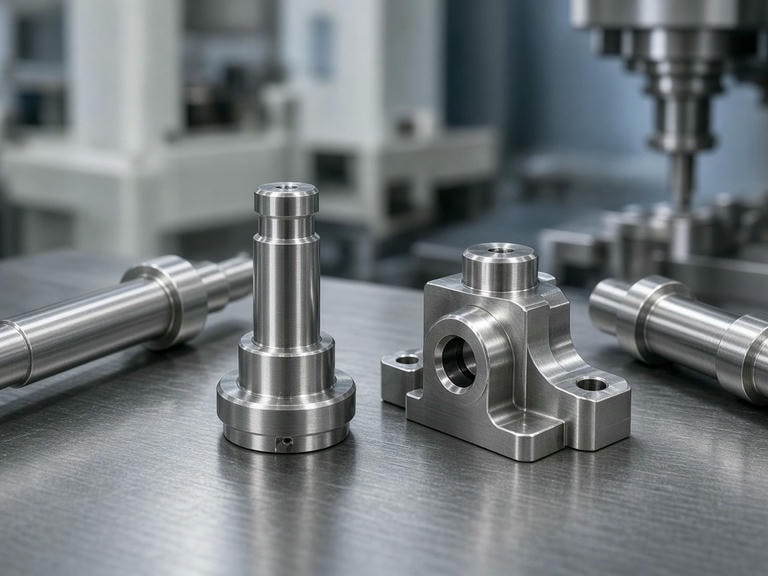
Martensitic precipitation hardening stainless steel component with precision milling and tight-tolerance bores.
Heat Treatment Conditions & Mechanical Performance
17-4 PH (AISI 630 / UNS S17400) provides exceptional strength, corrosion resistance, and structure retention. Depending on specific working loads, selecting the exact aging state controls the yield, elongation, and Rockwell hardness envelope.
| Condition | Tensile Strength (MPa) | Yield Strength (MPa) | Hardness (HRC) | Density (g/cm³) |
|---|---|---|---|---|
| Condition H900 | 1310 | 1170 | 40 - 44 | ~7.8 |
| Condition H1025 | 1070 | 1000 | 35 - 38 | ~7.8 |
| Condition H1150 | 930 | 725 | 28 - 32 | ~7.8 |
17-4 H900 Machining Application
Delivers extreme yield stress and hardness for heavy friction, hydraulic components, and aerospace structural locks. Requires rigid tooling to counter work-hardening.
Condition H1025 Versatility
Provides balanced toughness and stress cracking protection. Ideal for power transmission shafts, high-pressure stems, and automated mechanical couplings.
Condition H1150 Ductility
Preferred when superior impact resistance, fracture toughness, and resistance to severe environmental fatigue are essential, such as offshore and downhole tooling.
Factory Machinery & Production Capacity
Maintaining ±0.005 mm repeatability in 17-4 stainless CNC machining demands high static stiffness and dynamic damping. Our facility relies on premier Japanese CNC platforms and metrology cells.
Mazak C600 5-Axis
Travel: 900 × 900 × 700 mm | 24,000 RPM
Designed for complex impellers, multi-faceted valve bodies, and aerospace mounts in single-clamping operations to eliminate cumulative setup drift.
Mazak Turning & Turn-Mill
10× QTC100MY • 12× QTE100 CNC Lathes
High-rigidity spindles engineered for uninterrupted shaft machining, concentric thread turning, and integrated live tooling milling in a unified envelope.
Prismatic Milling Cells
39× Mazak VCN-430AL • 18× FANUC VMC
High-volume 4-axis production lines capable of roughing bulk material rapidly under high-pressure through-spindle coolant delivery.
ZEISS CMM Validation
ZEISS (700 × 700 × 600 mm) • Sirius CMM
Equipped with scanning probe heads for complete GD&T verification, internal thread runouts, and surface profile documentation.
Deformation Management & Heat Treatment Workflow
Because 17-4 PH contracts uniformly during precipitation aging (approximately 0.04% to 0.06% volumetric shrinkage during H900 aging), heat treatment must be accounted for early in the machining cycle.
Our engineering team coordinates the sequence of metal removal and thermal stabilization to eliminate residual stresses and guarantee geometric tolerances post-heat treat.
Annealed Rough Machining (Condition A)
We remove the bulk volume while the alloy is in the solution-annealed state, leaving uniform 0.3–0.8 mm finishing stock on critical functional surfaces and reference datums.
Intermediate Stress Relief
For asymmetrical profiles, thin-walled aerospace housings, or long shafts, parts undergo thermal stress mitigation prior to hardening to eliminate internal micro-strains.
Precipitation Hardening Heat Treat
Components enter vacuum or inert atmosphere furnaces calibrated precisely for H900 (480°C / 1 hr), H1025, or H1150 aging, achieving the specified tensile properties and core hardness.
Hardened Precision Finish Machining
Using high-rigidity Mazak spindles, dedicated carbide/cBN tooling, and high-pressure lubrication, final bores, sealing lands, and bearing surfaces are finished directly in the hardened state.
Inspection Infrastructure & Verification
Every batch of 17-4 PH CNC components is verified for compositional integrity, hardness response, and dimensional compliance prior to final release.
Coordinate Metrology (CMM)
ZEISS (700 × 700 × 600 mm) and Sirius CMM workstations with temperature-compensated envelopes verify concentricity, perpendicularity, true position, and fine geometric features.
Hardness & Material Analysis
Calibrated Rockwell and Vickers testers verify post-aging hardness (e.g. 40–44 HRC for H900). Handheld XRF spectrometers verify genuine 17-4 alloy composition against chemical certifications.
Surface & Optical Metrology
Mitutoyo profilometers confirm Ra surface finish requirements down to Ra 0.4 μm. High-resolution 2.5D optical measuring systems inspect chamfers, external radii, and complex profiles.
Critical Components Machined From 17-4 PH
When components demand tensile strength over 1000 MPa alongside reliable atmospheric and chemical resistance, 17-4 PH serves as a leading alloy for engineered systems.
Aerospace Hardware
Structural • Flight Controls
Structural bracketry, turbine impellers, high-shear lock bolts, hinge fittings, and actuator links exposed to high dynamic loads.
Automation & Robotics
Kinematics • Drive Links
High-torque gear drive shafts, heavy-duty robotic wrist couplings, guide pins, and high-frequency clamping end-effectors.
Energy & Petrochemical
Pressure • Downhole
High-pressure choke valve stems, severe-service pump shafts, manifold flanges, and offshore subsea connector housings.
Precision Equipment
Instrumentation • Tools
Analytical device chassis, centrifuge rotors, surgical tool bodies, and corrosive fluid metering blocks requiring extreme dimensional stability.
17-4 PH Stainless Steel Machining FAQs
Engineering guidance on tooling, feeds, heat treatment, and tolerance preservation.
Upload Your 17-4 PH Part Drawing
Send your CAD models (.STEP, .IGES, .X_T) and technical prints with GD&T specifications. Our engineering team reviews heat treatment conditions, machinability, and provides complete DFM feedback with quote within 24 hours.
Request a Machining Quote
Specify material temper (H900, H1025, H1150), quantity, and delivery timeline.