Precision PPS CNC Machining Services
PRECI5 delivers tight-tolerance machining for Polyphenylene Sulfide (PPS) components. Powered by multi-axis Mazak machining centers and validated by ZEISS CMM metrology, we manufacture mission-critical PPS parts for semiconductor, chemical handling, and extreme-temperature electronics.
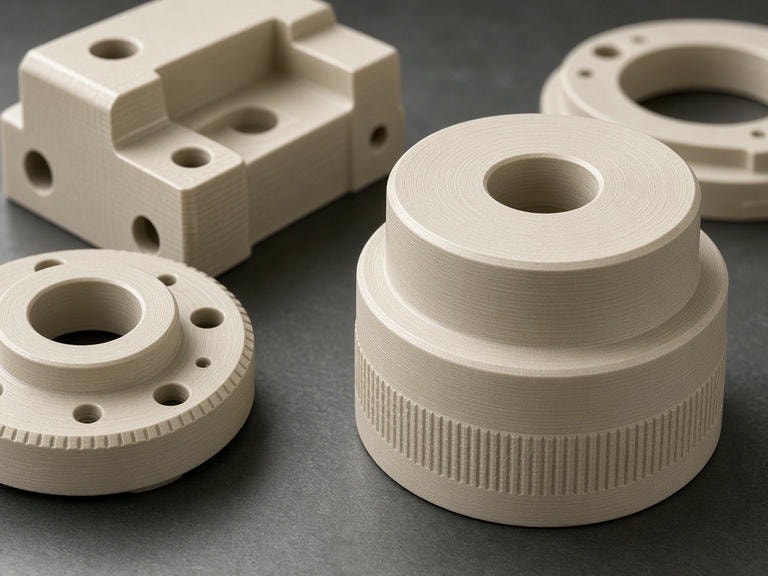
PPS Grade Material Characteristics
Polyphenylene Sulfide offers remarkable dimensional stability, near-zero moisture uptake, and chemical inertness comparable to fluoropolymers. Grade selection directly impacts machining parameters, tool wear, and end-use structural rigidity.
| Property | Unfilled Natural PPS | PPS 30-40% Glass-Filled | Machining & Application Impact |
|---|---|---|---|
| Density (g/cm³) | ~1.35 | ~1.60 – 1.65 | Increased mass and abrasive fiber loading in reinforced grades. |
| Tensile Strength (MPa) | ~80 – 90 | ~150 – 180 | Reinforced grades provide metal-replacement stiffness under load. |
| Continuous Service Temp (°C) | 200 – 220 | 220 – 240 | Short excursions up to 260°C; requires thermal stress relief. |
| Water Absorption (%) | < 0.05 | < 0.03 | Extremely hydrolytic; eliminates ambient swelling during operation. |
| CTE (10⁻⁶/K) | ~50 – 60 | ~20 – 30 | Glass-filled matches non-ferrous metals; controls thermal drift. |
Controlling PPS Machining Challenges
PPS possesses higher notch-sensitivity and lower elongation-at-break than softer thermoplastics like Delrin or PTFE. Our manufacturing protocols address the critical physical failure modes encountered during high-speed CNC milling and turning.
Burr Elimination & Edge Finish
PPS tends to produce feathering burrs at cross-holes and thin edges due to shear embrittlement. We program high-rake, polished carbide tooling with dedicated climb milling toolpaths to shear stock cleanly without plastic tear-out.
Friction & Machining Heat Control
Although PPS withstands 220°C continuously, sustained cutter friction induces localized thermal softening and dimensional growth. We utilize high-pressure chilled flood coolant or pure dry air blasts tailored to application cleanliness.
Relieving Internal Stress
Thick-walled PPS stock retains residual extrusion stress. For tight-tolerance components (±0.01 mm), we run roughing passes, apply intermediate stress-relief annealing cycles, and execute light finishing passes to prevent post-machining warpage.
114-Machine Infrastructure in Shenzhen
From fast-turn proto builds to high-volume semiconductor assembly contracts, our Shenzhen facility operates continuous production cells dedicated to advanced engineering plastics.
8 Mazak C600 5-Axis Units: Complex 3D contours, manifold ports, and deep pockets finished in a single setup to eliminate stacking datum error.
High-Speed Plastic Machining: Spindles up to 24,000 RPM permit optimal surface cutting speeds (SFM) without overloading cutting flutes.
Mazak QTC100MY Mill-Turn: Simultaneous live tooling for high-precision concentric valves, bushings, and chemical connectors.
Minimizes human transfer errors on intricate PPS housings, achieving concentricity and positional alignments under ±0.015 mm.
Provides the shear rate needed for ultra-smooth surface textures (Ra 0.8–0.4 µm) without micro-cracking brittle PPS matrices.
700 × 700 × 600 mm measuring volume. Complete 3D geometric dimensioning and tolerancing (GD&T) reporting for zero-defect compliance.
Verifies resin grade composition, glass fiber concentration, and compliance with RoHS, REACH, and semiconductor clean-room protocols.
Critical PPS Industrial Components
Where fluoropolymers lack structural rigidity and metals corrode, PPS CNC machined components deliver long-term reliability.
Semiconductor Processing
Components subject to aggressive wet bench chemistry, ozone cleaning, and wafer handling environments.
- Etch chamber vacuum manifolds
- Wafer retainers & carrier blocks
- Chemical delivery valve manifolds
Electronics & High Voltage
High-dielectric structural insulators withstanding lead-free reflow heat and continuous operational thermal loads.
- Automotive EV sensor brackets
- High-temperature terminal blocks
- Hermetic socket arrays
Chemical & Fluid Handling
Precision dynamic components operating in boiling solvents, acids, and high-pressure steam environments.
- Pump impellers & wear rings
- Chromatography meter blocks
- High-pressure fluid fittings
Design for Manufacturability Guidelines for PPS
PPS requires specific geometry rules to compensate for notch sensitivity and glass fiber orientation. Our engineering team conducts full DFM audits on incoming STEP/IGES/CAD files before tooling setup.
Upload Your PPS Part Drawing
Share your STEP, IGES, or 2D technical drawings. Our manufacturing engineers deliver a comprehensive feasibility review, DFM feedback, and competitive pricing within 24 hours.