AISI 4130 CNC Machining Services for Mission-Critical Assemblies
PRECI5 delivers ISO-certified 4130 steel machining for aerospace structures, high-pressure equipment, heavy brackets, and complex mechanical components. Operating from our Shenzhen facility, we combine high-rigidity multi-axis milling and turning to handle normalized, annealed, and heat-treated alloy steel to micro-inch precision.
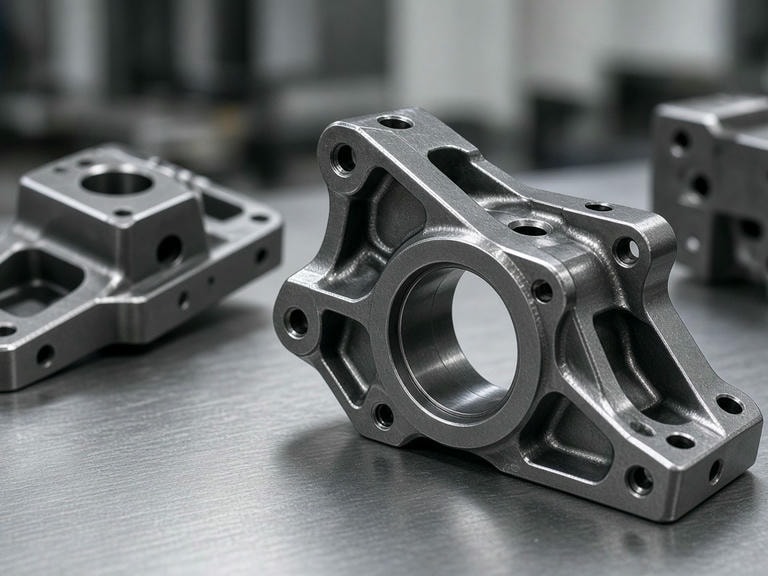
Engineering Properties of AISI 4130 (Chromoly Steel)
AISI 4130 is an alloy steel formulated with chromium and molybdenum, offering superior hardenability, fracture toughness, and fatigue endurance. Selecting between normalized and annealed raw stock determines cutting speed, chip formation, and stability during 4130 CNC machining.
| Mechanical & Physical Property | Normalized Condition | Annealed Condition | Machining Impact & Considerations |
|---|---|---|---|
| Density | 7.85 g/cm³ | 7.85 g/cm³ | Uniform mass calculation for aerospace structural load analysis. |
| Tensile Strength (Rm) | 670 MPa | 450 MPa | Normalized stock exhibits higher shear resistance, demanding rigid tool setups. |
| Yield Strength (Rp0.2) | 460 MPa | 290 MPa | Higher yield in normalized states reduces deflection under aggressive milling paths. |
| Hardness | 197 HB | 140 HB | Annealed is softer for high-speed hogging; normalized delivers crisp surface finishes. |
| Elongation (A5) | 25% | 30% | Requires dedicated chip-breaker geometry to prevent long ribbon nesting during turning. |
Material Selection: AISI 4130 vs. AISI 4140
Engineers frequently evaluate 4130 versus 4140 steel for industrial and mechanical designs. While both are chromium-molybdenum alloys, carbon concentration dictates their structural response and optimal post-processing path.
AISI 4130 (0.28 – 0.33% Carbon)
Lower carbon content offers superior ductility and weldability compared to 4140. It is engineered for fabricated assemblies, tubular airframes, roll cages, engine brackets, and pressure-containment hardware that require welding before or during finish CNC machining.
- • Superior Weldability: Low susceptibility to cracking under proper pre-heat parameters.
- • Impact Toughness: Resists cold-weather shock loads in aerospace and motorsports chassis.
- • Best Suited For: Aerospace brackets, hydraulic manifold blocks, and welded frames.
AISI 4140 (0.38 – 0.43% Carbon)
Higher carbon concentration enables greater core depth hardening and abrasion resistance. However, elevated carbon increases cracking propensity during fusion welding, requiring mandatory pre-heating, post-weld stress relief, and more rigid clamping.
- • Higher Core Hardness: Can achieve up to 58 HRC through quench and temper processes.
- • Wear Resistance: Excellent performance under heavy cyclic torsional stresses.
- • Best Suited For: Splined drive shafts, heavy-duty gearing, drill collars, and heavy pins.
Specialized Manufacturing Capacity for 4130 Steel
Machining chromoly alloy steel demands vibration-dampened tool spindles, rigid fixturing, and advanced carbide tooling. Our Shenzhen production plant houses 69 high-rigidity CNC machining centers optimized for 4130 steel machining.
Travel envelope up to 900 × 900 × 700 mm. Enables complex structural bracket and aerospace mount fabrication in single-clamping operations, eliminating cumulative datuming errors.
High-rigidity column design with dynamic high-torque spindles specifically tuned for high-depth roughing and high-feed pocket milling in normalized 4130 billets and plates.
Integrated live tooling and sub-spindle setups for cylindrical 4130 parts, performing cross-drilling, keyway cutting, and external threading in synchronized single-cycle turn-milling.
Secondary Machining for Welded 4130 Fabrications
Welded 4130 assemblies frequently undergo localized distortion, thermal stresses, and microstructural phase changes in the Heat-Affected Zone (HAZ). For secondary CNC machining of welded structural brackets or tubular airframe mounts, all machining routines require mandatory project-by-project evaluation.
Stress-Relief History
Post-weld heat treatment (PWHT) data must be provided to ensure dimensional stability during and after metal removal.
Custom Fixturing
Our engineering team designs custom modular soft jaws and dampening mandrels to eliminate chatter on thin-wall weldments.
Have a Welded 4130 Assembly?
Submit your assembly drawings with datum points and weld symbols. Our DFM specialists will assess tolerance feasibility and clamping paths.
Upload Your AISI 4130 DrawingQuality Assurance & Metrology Inspection
PRECI5 enforces strict quality control at every stage of 4130 CNC machining, verifying raw alloy composition, heat treatment conformance, and tight geometric tolerances.
Full 3D coordinate measuring verification for GD&T features, true position, perpendicularity, and runout on complex 5-axis components.
Positive Material Identification (PMI) to confirm Cr (0.80–1.10%) and Mo (0.15–0.25%) levels against mill test certificates (MTR).
Benchtop hardness validation across core sections and weld heat-affected zones to verify normalized or quench-and-tempered status.
Contact profilometer measurement verifying seal surface finishes down to Ra 0.4 µm (16 µin) for hydraulic valves and shafts.
Frequently Asked Questions: 4130 CNC Machining
Common technical inquiries regarding tool wear, surface treatments, heat treatments, and lead times for AISI 4130 steel components.
What surface finishing options are available for machined 4130 parts?
How does PRECI5 manage tool wear and work hardening during 4130 machining?
What documentation and material certifications accompany each batch?
Request a Manufacturing Quote
Upload your STEP, IGES, or 2D technical drawings for rapid DFM evaluation. Our engineering department reviews alloy conditions (normalized, annealed, or Q&T), tolerance callouts, and secondary post-machining requirements within 24 hours.
AISI 4130 RFQ Submission
Provide project specs for volume manufacturing or rapid prototyping.