Precision PTFE & Teflon CNC Machining Services
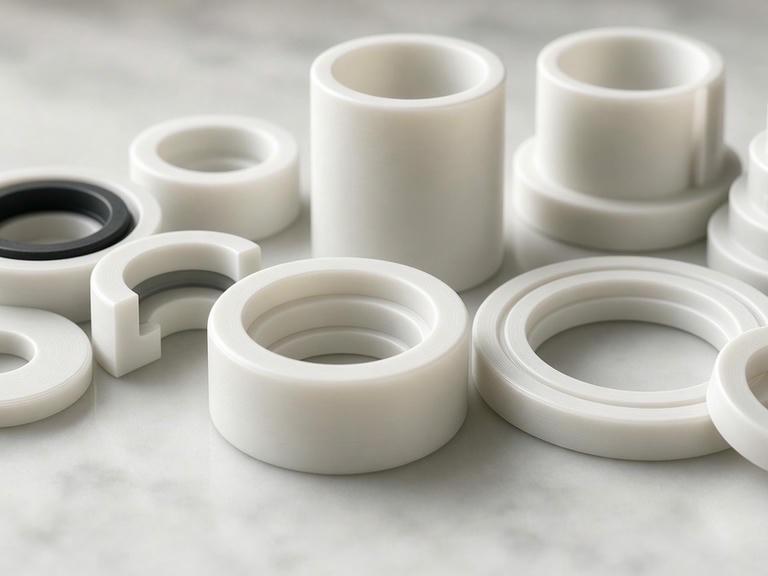
PRECI5 delivers tight-tolerance PTFE CNC machining for critical fluidic, electrical, and chemical processing applications. Polytetrafluoroethylene (widely recognized under the Chemours brand name Teflon) offers superior chemical inertness and extreme lubricity, but requires specialized machining techniques to mitigate mechanical deformation, cold flow, and thermal expansion.
PTFE Material Characteristics & Physical Properties
Teflon machining demands strict process controls. PTFE exhibits notable viscoelasticity: it is mechanically soft, vulnerable to clamping deformation, and prone to creep (cold flow) under sustained loads. Controlling its high Coefficient of Thermal Expansion (CTE) is essential to eliminate dimensional deviation during roughing and finishing cycles.
| Material Property | Typical Value (Virgin PTFE) | Machining Implication |
|---|---|---|
| Density | 2.1 – 2.3 g/cm³ | High bulk density requires balanced cutter dynamics during high-speed feed passes. |
| Tensile Strength | 15 – 30 MPa | Low tensile modulus permits tearing instead of shearing if tool edges are not polished razor-sharp. |
| Continuous Service Temp | -200°C to 260°C | Superb thermal threshold, but heat concentration during cutting causes local plasticization. |
| CTE (Thermal Expansion) | 100 – 160 x 10⁻⁶/K | Approximately 10x higher than aluminum. Strict temperature-controlled coolant is mandatory. |
| Water Absorption | < 0.01% | Near-zero moisture swelling enables consistent washdown and immersion applications. |
Engineering The Cold-Flow Profile
Because virgin PTFE displays continuous plastic deformation under load without fracture, parts will experience dimensional relaxation after being released from standard three-jaw chucks or vises.
- Elastic Memory & Recovery: Part dimensions shift over 24 hours post-machining as internal stresses equalize.
- Wall Collapse: Thin-walled cylinders easily deflect under radial tool pressure, resulting in taper or out-of-roundness.
- Burr Formation: Soft fluoropolymers yield elastomeric burrs that cannot be deburred by tumbling; manual razor or cryogenic deflashing is required.
Precision Workholding & Manufacturing Methodology
Machining precision PTFE parts requires non-traditional mechanical strategies. We utilize specialized tooling geometry, thermal management, and stress-neutral fixturing across our 114 Mazak and FANUC machining units.
Custom Fixturing & Soft Jaws
Standard metal vices concentrate point-load stress, indenting the stock. We manufacture custom aluminum pie jaws, collet sleeves, and vacuum plates that distribute clamping force around 360° of the circumference to eliminate part distortion.
Multi-Stage Stress Normalization
For tight-tolerance geometries, we perform rough machining leaving 0.5mm stock, allow internal stress relaxation at ambient clean-room temperature, and then proceed with light finishing cuts to lock in critical geometric tolerances.
High-Velocity, Low-Load Shearing
Running polished single-crystal diamond (PCD) and ultra-sharp carbide end mills at spindle speeds up to 24,000 RPM shears the fluoropolymer cleanly. High chip evacuation rates extract friction heat instantly before it expands the workpiece.
Inspection Protocol for Compliant Polymers
Standard vernier calipers, drop indicators, and contact micrometers exert sufficient mechanical force to compress Teflon, generating false dimensional readings. Our Shenzhen quality laboratory utilizes non-contact optical and precision low-force metrology systems to verify compliance without part deflection.
Metrology Standard:
Components stabilize inside an environmentally regulated metrology suite (20°C ± 0.5°C) for 12 hours prior to final CMM sign-off.
Material Selection & Engineering DFM Guidance
Our engineering team assists during early prototyping to match exact fluoropolymer formulations with your functional criteria, lowering piece costs and stabilizing dimensions.
Virgin vs. Filled PTFE Grades
While virgin PTFE provides superior dielectric performance and FDA compliance, filled grades significantly enhance mechanical resilience:
- Glass-Filled (15% - 25%): Improves compressive strength, lowers creep, and enhances dimensional stability under thermal cycling.
- Carbon-Filled (10% - 35%): Enhances thermal conductivity and wear resistance; reduces static buildup in volatile environments.
- Bronze-Filled (40% - 60%): Maximizes wear resistance and thermal dissipation for heavy-load hydraulic bearings and wear rings.
Design for Manufacturing (DFM) Rules
Incorporate these practical mechanical guidelines into your 3D CAD models before requesting a manufacturing quote:
- Avoid Razor-Thin Walls: Maintain wall thicknesses greater than 0.8 mm (0.030 in) whenever possible to prevent elastic deflection during cutting.
- Specify Practical Radii: Internal corner radii should exceed tool radius to reduce chatter and cutter drag marks.
- Realistic Tolerancing: Because of high CTE, avoid metal-style tolerances (e.g. ±0.005 mm) on virgin material unless stabilized inside filled polymers.
Request a Quote for Your PTFE Parts
Whether you need a rapid prototype batch to test a dynamic seal or production-scale runs on 5-axis Mazak machining centers, PRECI5 provides certified quality, traceable resins, and tight-tolerance fluoropolymer machining.
Upload Part Specifications
Our applications engineers typically review drawings and return DFM analysis with pricing within 24 business hours.